Projector radiometric compensation using a 2D spectroradiometer
Yoshiaki Maeda and Daisuke Iwai, Optics Express 34(9), 15979-15993 (2026). A projector radiometric compensation method using a 2D spectroradiometer.
Abstract
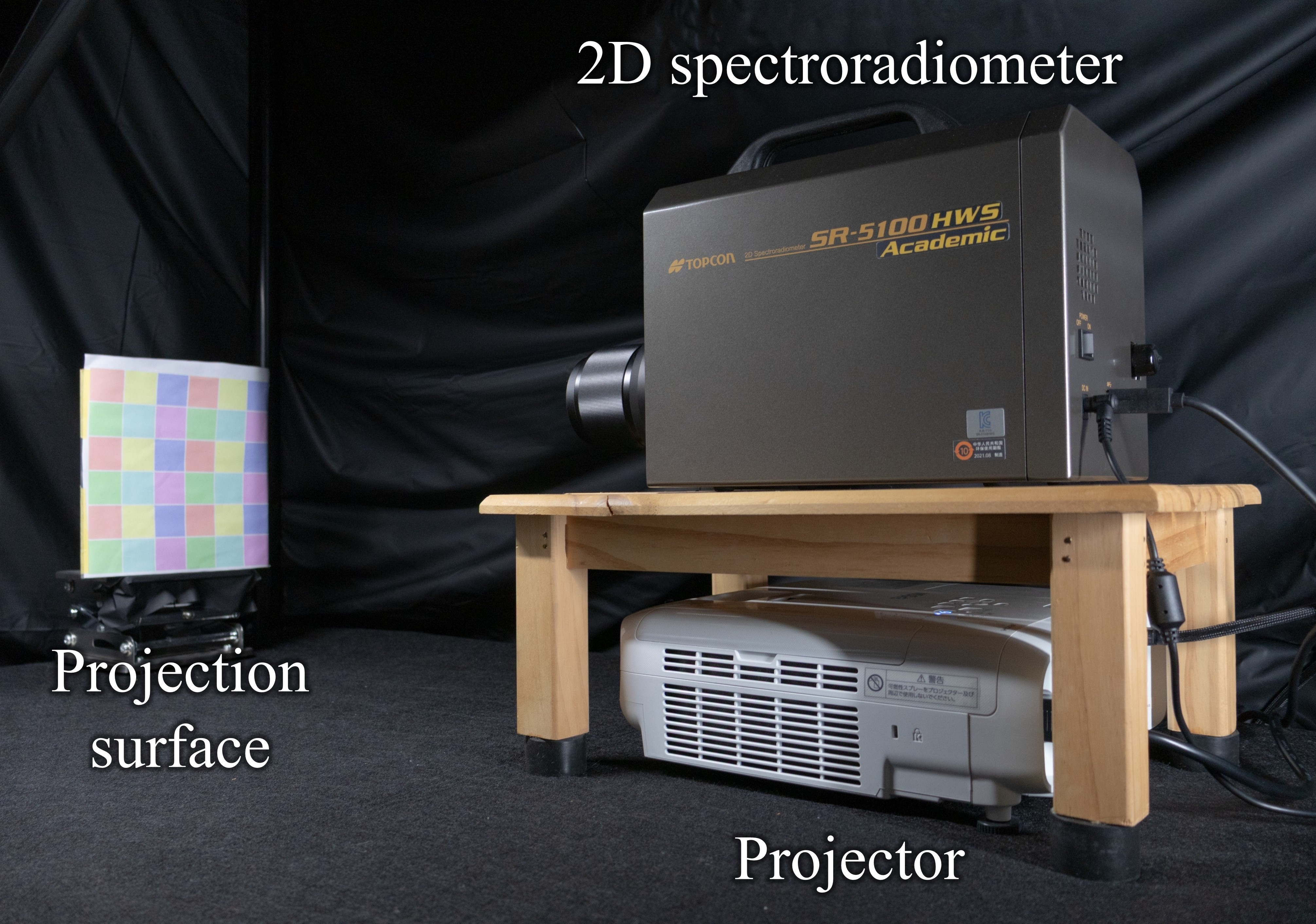
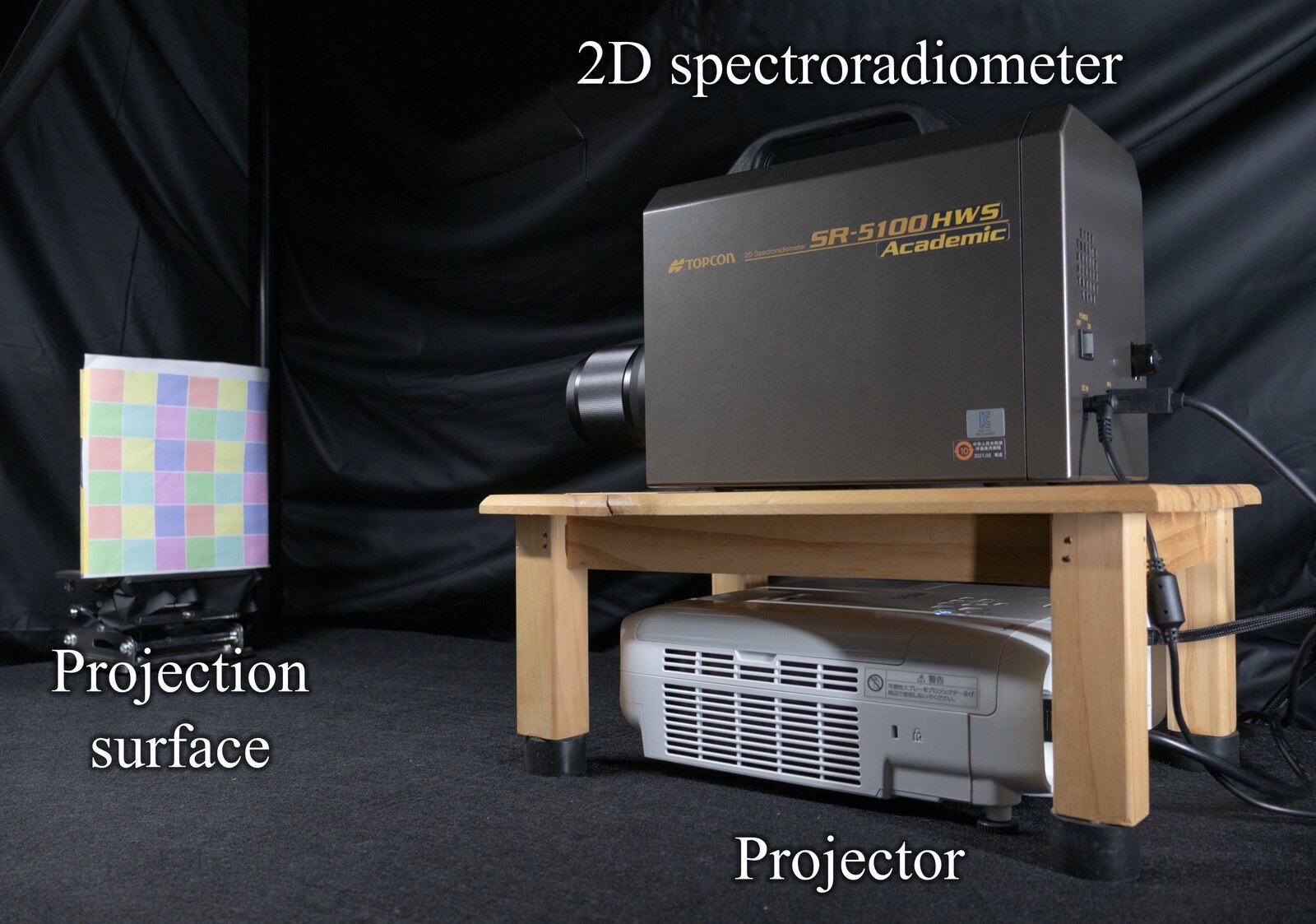
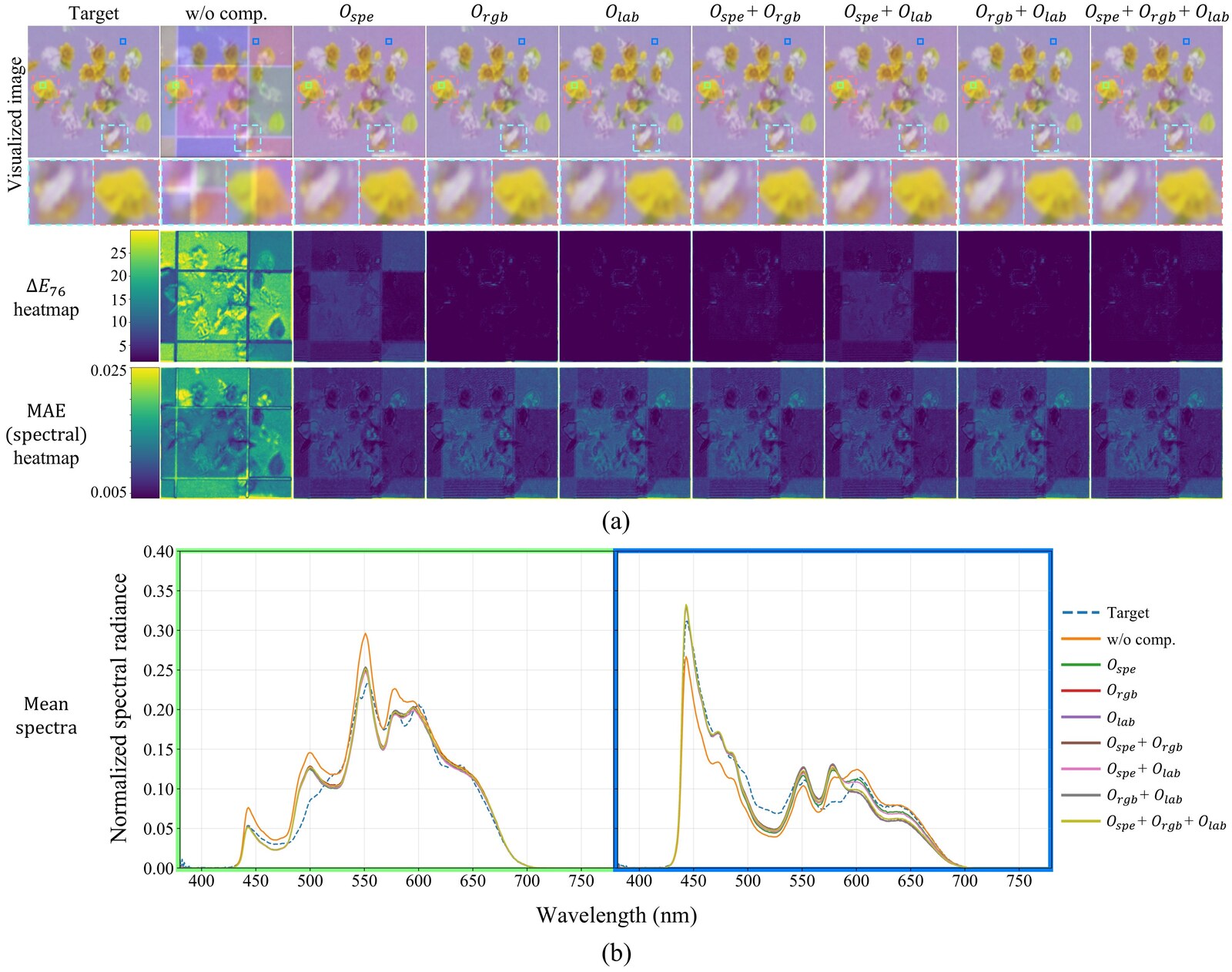
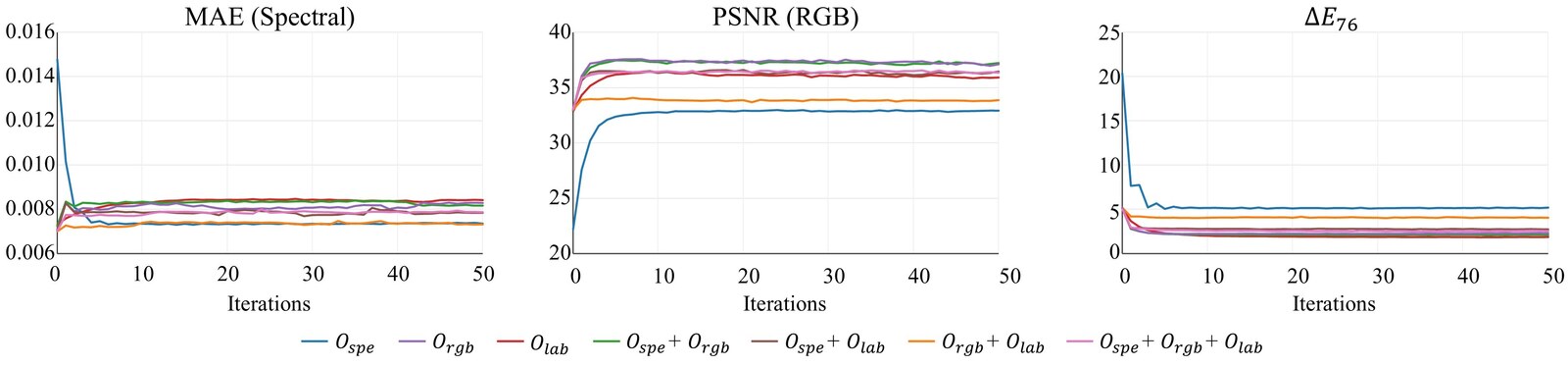
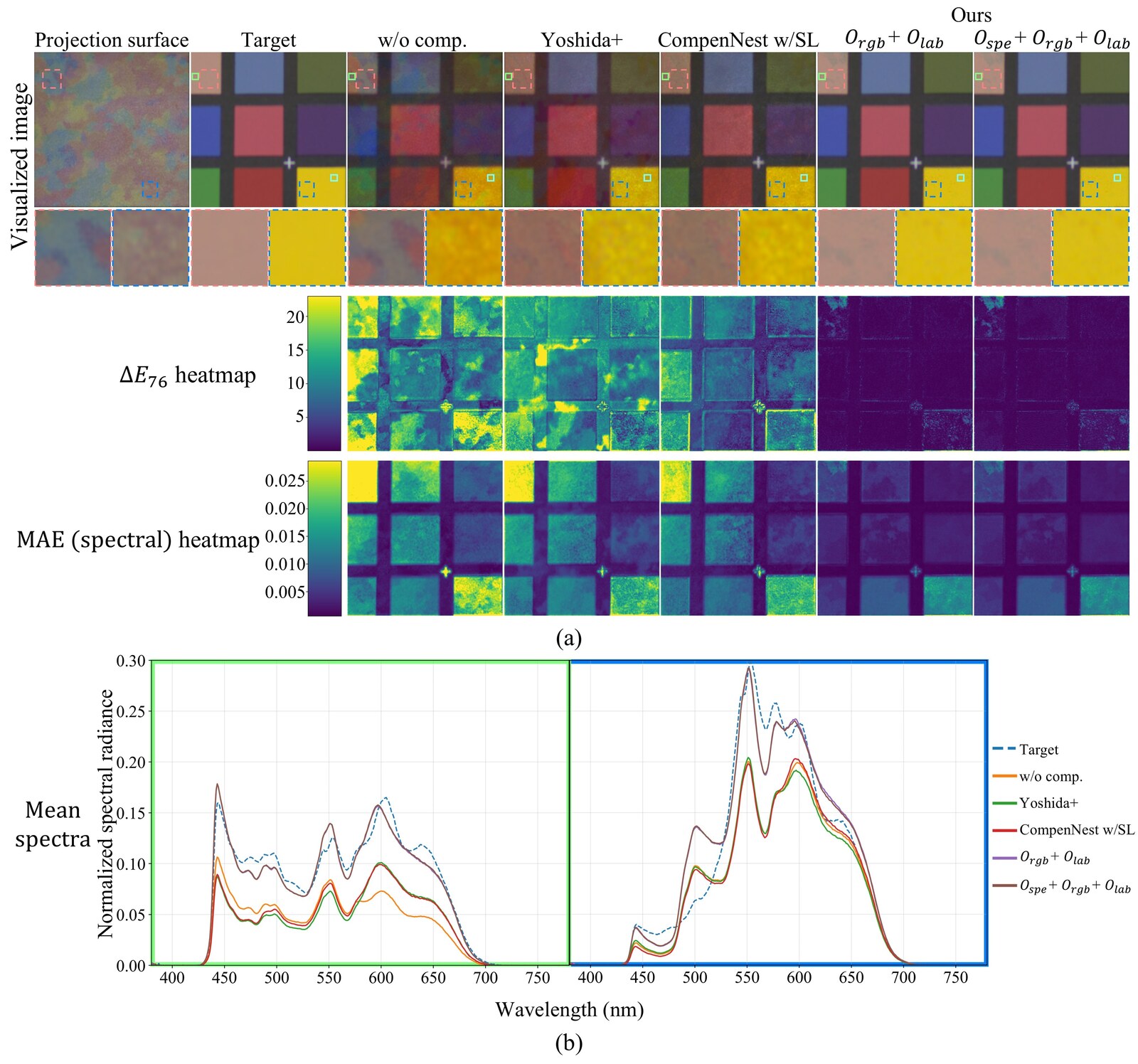
Projection mapping (PM) optically overlays computer-generated imagery onto real-world objects, enabling users to experience augmented reality without wearing any display devices. However, surface textures often cause color distortion, leading the displayed colors to deviate from the desired colors. To address this issue, we propose a projector radiometric compensation method that minimizes the color difference between a target image and the projected result using a 2D spectroradiometer (2DSR). In the proposed method, we model the color transformation between the projector and the 2DSR in a differentiable manner. Based on this formulation, we propose two optimization strategies for projector radiometric compensation: (i) minimizing the spectral error between the target appearance and the projected result, and (ii) minimizing the color difference measured in a differentiable color space designed to reflect human visual perception. Experiments with a physical prototype demonstrate that our method achieves more accurate projector radiometric compensation and better alignment with human color perception than conventional methods using an RGB camera.
Citation
Yoshiaki Maeda and Daisuke Iwai, "Projector radiometric compensation using a 2D spectroradiometer," Opt. Express 34, 15979–15993 (2026)
@article{maeda2026projectorRadiometricCompensation,
  title   = {Projector radiometric compensation using a 2D spectroradiometer},
  author  = {Maeda, Yoshiaki and Iwai, Daisuke},
  journal = {Optics Express},
  volume  = {34},
  number  = {9},
  pages   = {15979--15993},
  year    = {2026},
  month   = {Apr},
  doi     = {10.1364/OE.596052}
}
Figures 1–4 reproduced from (Maeda & Iwai, 2026), published under the Optica Open Access Publishing Agreement.